Chuyên sản xuất và cung cấp đầy đủ các loại thanh nhôm định hình và các sản phẩm gia công kim loại

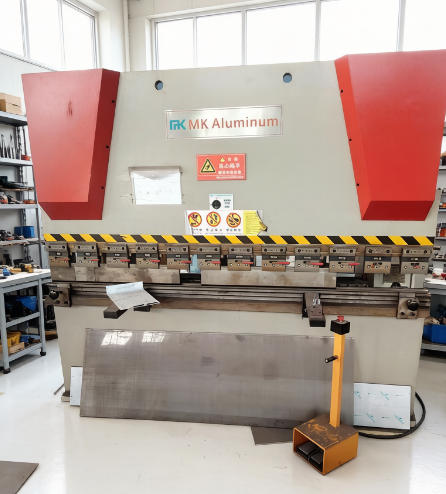
cnc bending
CNC Bending (Computer Numerical Control Bending) is a precision metal forming process that uses a CNC-controlled press brake or tube bender to plastically deform sheet metal or tubes. Unlike manual bending, CNC bending automates the entire process based on programmed commands, enabling high accuracy, repeatability, and complex bend geometries.
⚙️ Working Principle
-
Programming – The operator enters parameters into the CNC controller: bend angle, backgauge position, pressing force, etc.
-
Control & Execution – The system precisely controls the ram stroke, bottom dead center, backgauge positioning, and applied pressure.
-
Forming – The punch and die (e.g., V-die) apply force to the workpiece, causing plastic deformation.
-
Intelligent Compensation – High-end CNC systems automatically compensate for springback (material’s tendency to partially return to its original shape), ensuring accurate final angles.
📌 Main Types & Applications
| Danh mục | Typical Equipment / Process | Ứng dụng |
|---|---|---|
| 📄 Sheet Metal Bending | CNC Press Brake – most common; uses punch and V-die to create straight bends. | Automotive (~40% of applications), aerospace, construction, electronics enclosures, elevators, furniture. |
| 🔩 Tube / Pipe Bending | CNC Tube Bender – can use mandrels to prevent wrinkling or flattening. | Automotive exhaust/fuel lines, aerospace tubing, HVAC systems, medical devices, fitness equipment. |
| ⚙️ Multi‑Axis Bending | Complex spatial bending on a single workpiece. | Precision complex parts for high‑end manufacturing. |
✅ Key Advantages
-
High precision & repeatability – Accuracy down to ±0.01 mm; consistent results for large batches.
-
High efficiency & flexibility – Reduced setup times; quick program changeover for small batches or custom work.
-
Lower cost & safety – Minimized waste; built‑in safety devices (light curtains, safety relays).
🔧 Core Technologies & Selection Guide
Drive Technology Comparison
| Drive Type | Features | Pros | Cons |
|---|---|---|---|
| Electro‑hydraulic servo | Hydraulic power + servo control (~70% market share) | High tonnage for thick plates; mature & cost‑effective | Higher energy consumption & noise than all‑electric |
| All‑electric | Servo motors directly drive the ram (no hydraulic oil) | 50‑70% energy savings; higher speed & accuracy; lower maintenance | Higher initial cost |
-
CNC Controllers – Common brands: DELEM (Netherlands), ESA (Italy).
-
Closed‑loop compensation – High‑end machines use linear scales (accuracy ±0.01 mm) to compensate for mechanical deflection.
Three Bending Methods (Sheet Metal)
| Method | Description | Best for |
|---|---|---|
| Air bending | Ram depth controls angle; lower force needed. | General‑purpose bending. |
| Bottoming / Coining | Punch and die fully compress the material at bottom dead center. | High angle accuracy; tight tolerances. |
| Three‑point bending | Adjustable two‑point support + punch gives precise angle control. | Highest precision applications. |
📝 How to Choose a CNC Bending Machine
When selecting a CNC press brake or tube bender, consider:
-
Material & workpiece – Type (sheet/tube), thickness, length, and strength.
-
Required accuracy & throughput – e.g., ±0.01 mm or ±0.5°; high‑volume or job‑shop.
-
Machine specifications – Tonnage (force) and bed length. Tonnage depends on material thickness & length; bed length must exceed the longest bend edge.
-
Automation level – Automatic tool changers, robotic loading/unloading for increased productivity.